
A leak you can hear at a coupling is wasting compressor output, and a leak you cannot hear still drops the pressure the cylinders see. The tip sheet cited below says leaks often waste 20 to 30 percent of a compressor’s output. That range is the sheet’s statement. It is not a survey of this site.
This page is based on public documents, not a test by this site. The method and the flow table are from U.S. Department of Energy Compressed Air Tip Sheet #3, “Minimize Compressed Air Leaks”, revised August 2004, prepared with the Compressed Air Challenge. The PDF was fetched on 15 October 2026. The ultrasound definition is from Robin Marcinkus, UE Systems, in Compressed Air Best Practices on 3 November 2025. That library copy was fetched on 7 October 2026 and read on 15 October 2026.
The blank worksheet is the file this title promises: leakage-survey-worksheet.txt. It sits in the compressed air section, next to the purity-class note.
What the walk includes
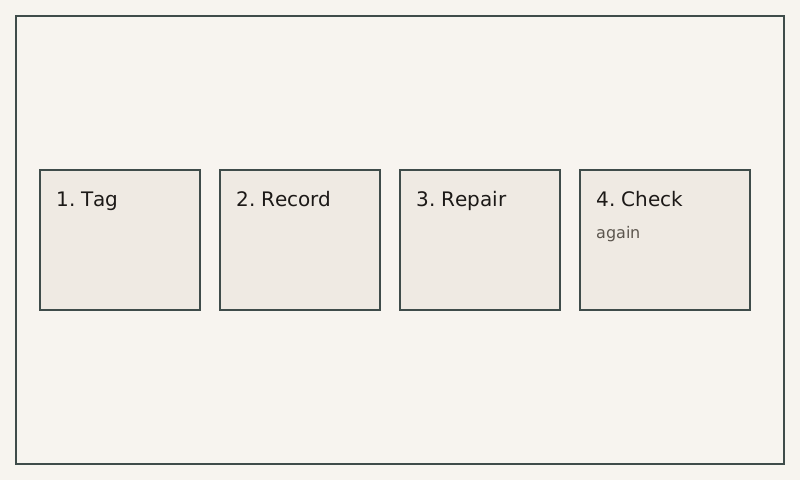
The sheet says a leak program should include identification and tagging, tracking, repair, verification, and employee involvement. It calls 5 to 10 percent of total system flow a typical target for industrial facilities. After repairs, it says to look at the supply again and reduce compressor run time so it matches the lower demand, with a compressed air specialist adjusting the controls.
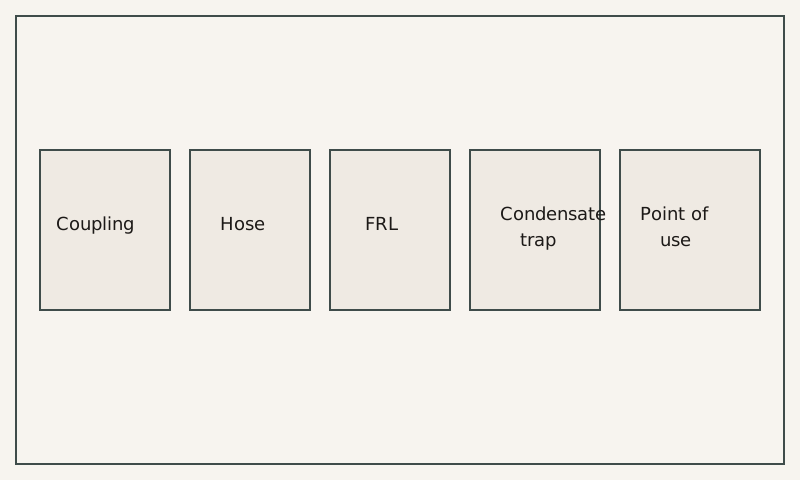
Places it names: couplings, hoses, tubes, fittings, pipe joints, quick disconnects, FRLs (filter, regulator and lubricator), condensate traps, valves, flanges, packings, thread sealants, and point-of-use devices. Leakage, it says, rises with supply pressure in an uncontrolled system and is proportional to the square of the orifice diameter.
How the leaks are found
The tip sheet calls an ultrasonic acoustic detector the best way to find leaks, because it recognizes the high-frequency hiss. It also says soapy water applied with a paintbrush is reliable, and that this method is time consuming. Marcinkus defines ultrasound as sound-pressure waves above 20 kHz, beyond human hearing, and describes a survey that tags the location, records the reading, and keeps unrepaired leaks on a list. He attributes a separate pair of figures to U.S. Department of Energy studies of industrial plants: only 50 percent of compressed air produced is used wisely, and approximately 30 percent is lost to leaks. That attribution is his. The tip sheet’s own range for waste is 20 to 30 percent of compressor output.
The same article notes that some proportional valves leak compressed air on purpose, and that this noise can confuse a listening survey. Mark an intentional vent on the sheet so it is not tagged as a failure. A reject ram’s exhaust is one place that distinction matters, on the reject checklist.
Two cells from the published rate table
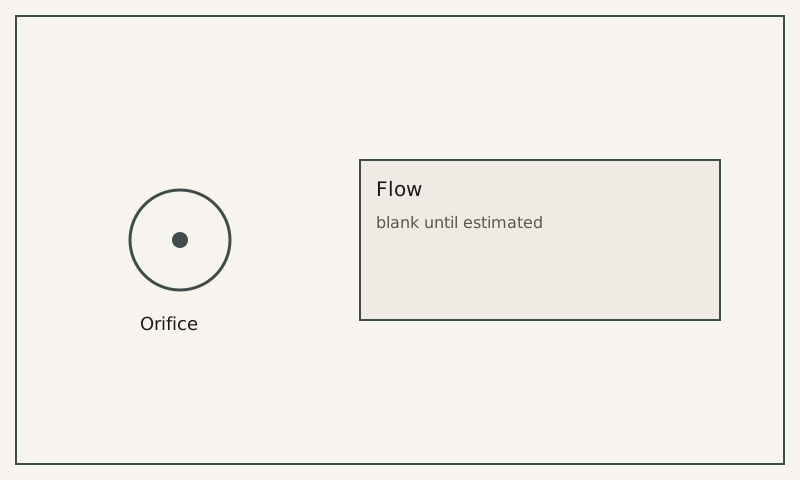
The tip sheet table, which it says is used with permission from Compressed Air Challenge training, gives leakage in cubic feet per minute for a supply pressure and an approximate orifice. Two cells, read from that table: at 90 psig a 1/16 inch orifice is listed as 5.72 cfm, and at 100 psig a 1/4 inch orifice is listed as 100.9 cfm. The sheet says to multiply by 0.97 for a well-rounded orifice and by 0.61 for a sharp one. If you have not estimated an orifice, leave the flow cell blank. Do not invent a share of air saved.
The full table is in the tip sheet. This page does not reprint every pressure and every diameter, and it does not reprint the sheet’s dollar example.
The blank sheet
| Tag | Place | Pressure | Method | Intentional vent? | Repaired | Checked again |
|---|---|---|---|---|---|---|
| — | Coupling, hose, FRL, trap, valve, other | — | Ultrasonic or soap | Yes or no | — | — |
| — | — | — | — | — | — | — |
The same columns are in leakage-survey-worksheet.txt. Port pressure after a leak is one reason the cylinder page asks for the pressure at the work port, not the compressor nameplate. Purity class is a different record, on the air preparation note.