
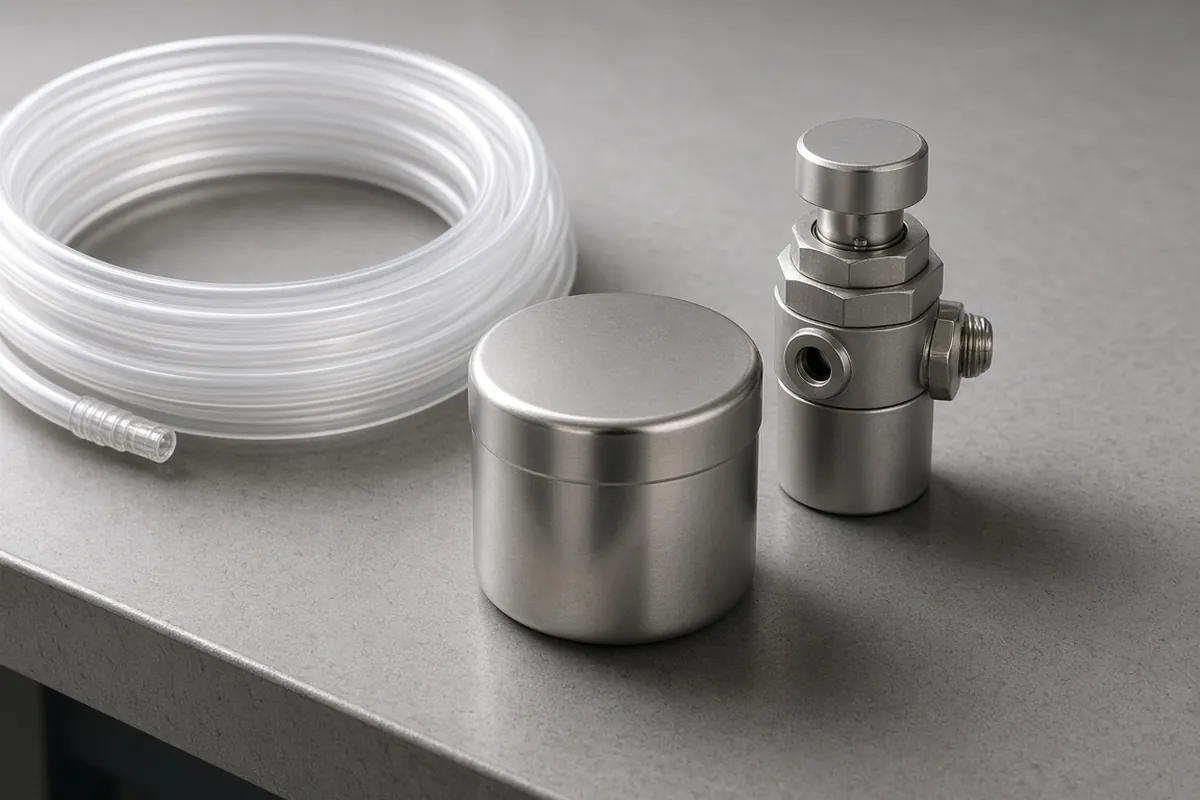
Wet or dirty air at a blow-off fails the pack that air touches, and a hose after the filter can put particles back into air that passed at the compressor. Write the purity class the process needs, then sample at the point of use.
This page is based on public documents, not a test by this site. The class rules are from Ruby Ochoa, president of Trace Analytics, in Compressed Air Best Practices on 30 November 2015. The research-library copy was fetched on 7 October 2026 and read on 15 October 2026. The filter-regulator-lubricator leak note is from U.S. Department of Energy Compressed Air Tip Sheet #3, revised August 2004, fetched on 15 October 2026.
The compressed air section holds this note and the leak survey. Cylinder inputs are on the selection questions.
What the air is carrying
Ochoa writes that compressed air is used in more than 70 percent of manufacturing activities. She cites the Compressed Air and Gas Institute for 10 contaminants in four groups: particles (pipe scale, wear particles and atmospheric dirt), water (liquid, vapor and aerosol), oil (liquid, vapor and aerosol), and microorganisms.
ISO 8573-1:2010, as she describes it, sets purity classes for particles, water and oil. It does not set classes for gases or for microorganisms. The series has nine parts. Part 1 is the classes and the way they are written. Parts 2 through 9 cover sampling and analysis. She says the summary chart of every numeric limit is a figure on that article. This page does not redraw limits that figure did not put into the sentences below.
How a class is written
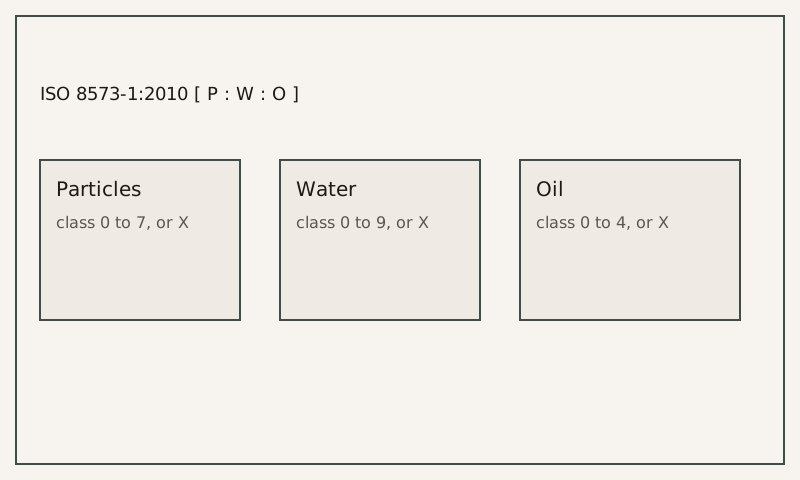
The designation she prints is ISO 8573-1:2010 [particles:water:oil]. Particle classes run from 0 to 7, plus X. Water runs from 0 to 9, plus X. Oil runs from 0 to 4, plus X. Her first example, [2:2:1], means class 2 particles, class 2 water and class 1 oil. A hyphen replaces a contaminant left unclassified, as in [2:-:1].
Class 0 still needs a number in the designation, and that number has to be stricter than class 1. Her third example is [1:2:0 (0.001)], which she reads as class 1 particles, class 2 water, and class 0 oil at 0.001 mg/m3. She writes that class 0 does not mean zero contaminants.
For particle classes 1 through 5 she adds a rule that is easy to miss on a summary chart: no particles greater than 5 microns. For oil classes 0, 1 and 2, the measurement includes aerosol and vapor. For classes 3, 4 and X, vapor is optional, because she writes there is no significant impact at or above 1.0 mg/m3.
The FRL is not the class
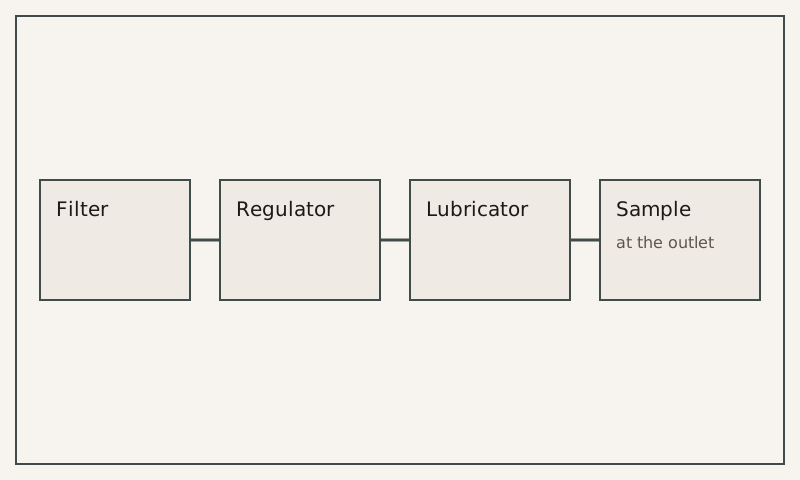
Tip Sheet #3 names the FRL, a filter, regulator and lubricator, among the common leak points, with couplings, hoses, tubes, fittings and point-of-use devices. The assembly does not by itself name a purity class. Match the filter to the class the product requires, and treat a leaking bowl as a survey item on the leak sheet.
Ochoa quotes a voluntary code, BCAS Food and Beverage Grade Compressed Air Best Practice Guideline 102: air in direct contact with the product should meet or exceed ISO 8573-1:2010 [2:2:1], and indirect contact [2:4:2]. The same passage says purity is tested at least twice a year and after maintenance that can change air quality. She also quotes the FDA text as it stood for that 2015 article, 21 CFR 110.40(g): compressed air or other gases mechanically introduced into food, or used to clean food-contact surfaces or equipment, shall be treated so food is not contaminated with unlawful indirect food additives. That is her citation, dated in 2015. Confirm the current rule before you treat the sentence as the one on your line.
Sample after the hose
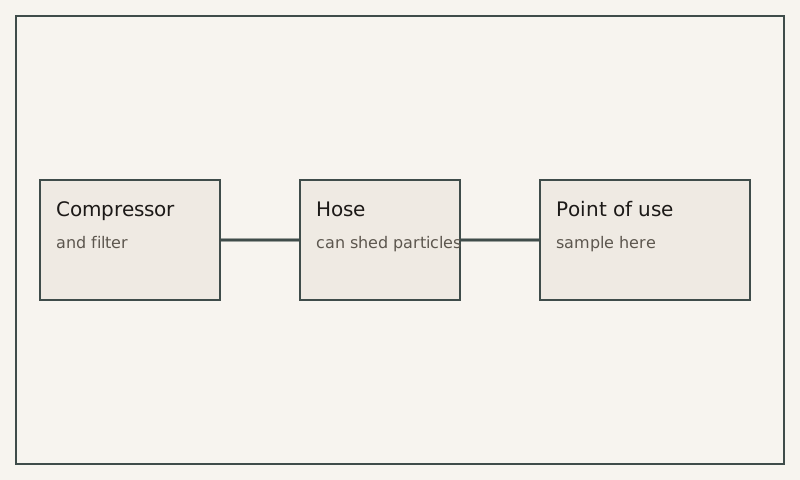
Ochoa writes that flexible tubing after a point-of-use filter can shed particles. Common rubber, nylon and other hose can undo air that was acceptable at the filter. Fittings and O-rings can shed particles as they age. She wants the sample at the point of use.
Her monitoring steps, shortened from the article: document the compressor type, the filters, the tank and the pipe material; draw the outlets and mark which ones touch the product; keep the maintenance record; test particles, water, oil and microorganisms at several points of use across the year, including just before a point-of-use filter change; then review the trend before a class is locked into the quality file.
This site does not test air and does not sell filters. The cylinder that uses the air is sized on the selection page, from pressure at the port, not from the compressor nameplate.