
A part number copied from an old label, with no document beside it, fails as a buying instruction. Match the characters to a document you hold, and write down what that document says the number is.
This page is based on public documents, not a test by this site. It does not decode a numbering system, and it does not print a parts table.
Between about 2013 and 2019 this domain hosted a third-party pneumatics catalog, the multilingual website of a pneumatics business of Bosch Rexroth, later renamed AVENTICS. This site is not that company, not a dealer, not authorised service, and does not sell parts.
The old catalog text, photographs, exploded diagrams and part-number tables are not republished here. A similar string of digits is not an equivalent and not an authorised replacement. The legacy documents section is this one note.
Copy the fields that are already on the paper
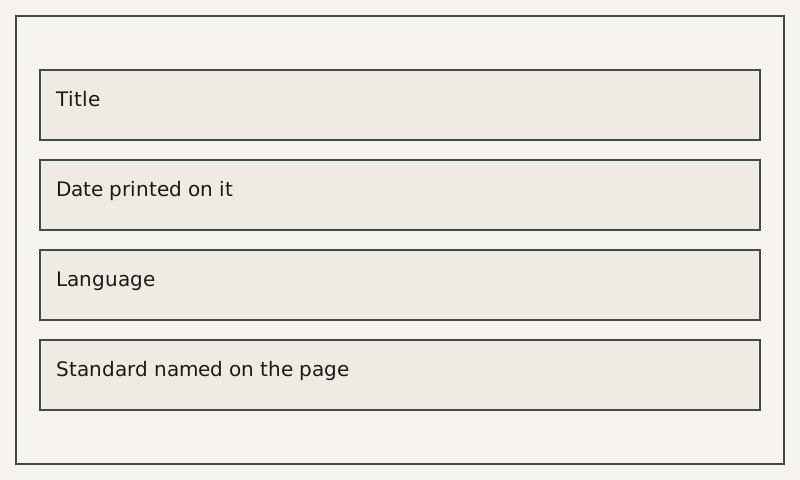
Write the document title, the date printed on it, the language, and any standard the page names. Two standard numbers that show up in public cylinder writing, not in a catalog on this site, are ISO 15552 and ISO 21287.
Josh Cosford’s “A designer’s guide to pneumatic cylinders” (Pneumatic Tips, 26 January 2026; library copy fetched 9 October 2026) mentions ISO 21287 as a compact, square-body construction. He writes that such cylinders are normally unique designs and are not interchangeable between manufacturers. A Fluid Power World article, “Time-honored process embraces food-safe pneumatics” (published 10 August 2018; library copy fetched 7 October 2026), states that the cylinders discussed there meet ISO 15552 and ISO 21287. Those sentences tell you the standards are named in public writing. They do not tell you what a particular old number means.
Do not invent the digits
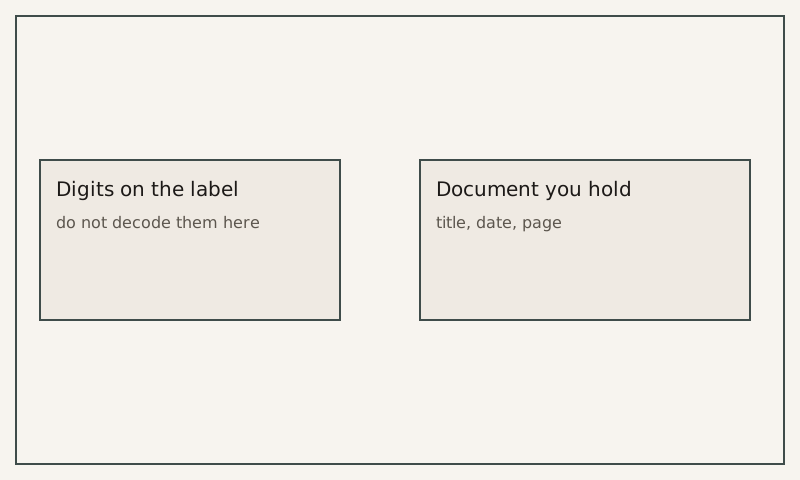
No part-number grammar was retrieved for this page, so none is printed. If the document you hold explains its own fields, copy that explanation onto your note and keep the page number. If it does not, stop. A neighbouring number in a list you remember is not a substitute, and this site will not name one.
Keep the new notes separate
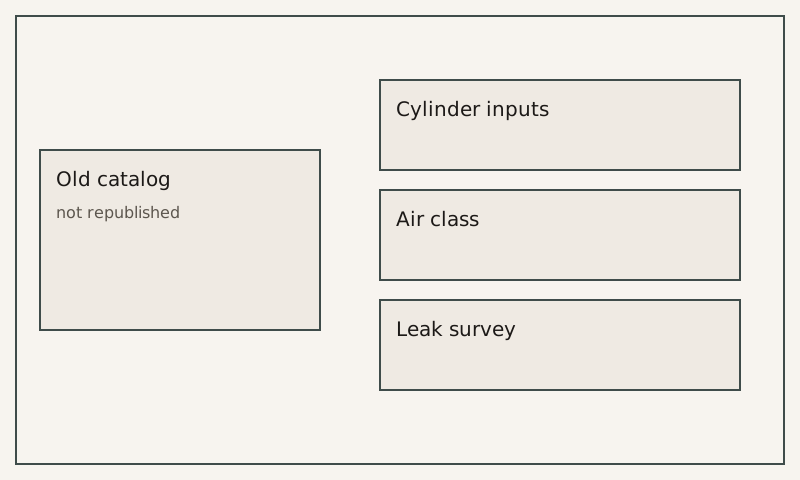
The current notes ask different questions. The cylinder page wants load, port pressure, stroke and mount. The air preparation page wants a purity class written as particles, water and oil. Neither page accepts an old catalog number as a specification.
| Field | Copied from the document |
|---|---|
| Title | — |
| Date printed on it | — |
| Language | — |
| Standard named on the page | — |
| Page where the number is defined | — |